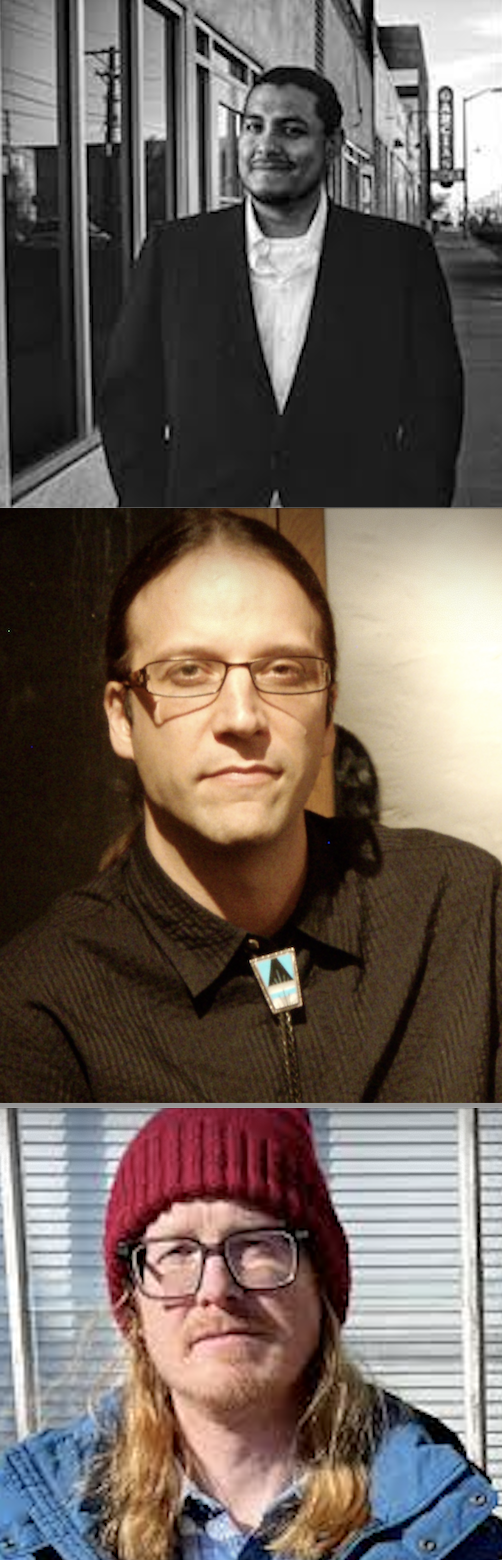
Ruben Olguin is a New Mexico based artist working in ceramics, adobe, sound, video, and electronic media. His work draws from his mixed Indigenous American and Spanish (mestizo) heritage. He incorporates traditional hand processes of earthen materials with modern elements. “My practice focuses on spending as much time in the desert as in the computer lab.” He has exhibited internationally in the U.S., Spain and Germany. A Graduate with an MFA from The University of New Mexico Department of Fine Arts in Electronic Arts, and holds a B.A. in Media Art from The University of New Mexico. He is currently Assistant Professor of Media and Art at Northern New Mexico College.His goals are to make and teach new media art along with socially engaged art practices.
Olguin has completed many community engaged art practices throughout his career. He has worked in Schools throughout the Southwest engaging STEAM based learning with earthen and electronic media. In 2019-20 he received the Fulcrum Grant where he implemented a community based art project in the Barelas neighborhood with students from Working Classroom and exhibited at the Barelas Community Center. He is currently working on a Santa Fe New Mexico Department of Art and Culture “Art is the Solution” grant. This project is a community outreach sculptural project producing Eroding Seed Sculptures in Santa Fe City Parks incorporating elements from students through workshops at local schools.
Working in installation based art, Olguin has exhibited works in the Southwest and beyond. These works include Installations in Santa Fe, NM, for Currents New Media Festival, The Paseo Project in Taos, NM, for Acequia Aqui. He has installed works in Marfa Texas, The Hood Museum in New Hampshire, Art Space in New Haven Connecticut, U-Moca in Salt Lake City Utah, and at the Albuquerque Art Museum.
Themes in his recent work explore how the landscape is divided by technology, land acquisition and modern transportation paths. Exposing these lines in the work, he considers how these divisions occurred and their effects on identity politics. Tracing paths of discontinuity through the history, culture and landscape of the Southwest.
Chad S. Hamill/čnaq’ymi is director of Indigenous Arts at CalArts. A composer, performer, and ethnomusicologist, Hamill’s scholarship is focused on song traditions of the Interior Northwest US, including those carried by his Spokane ancestors. In tandem with his research and teaching, Hamill is a recording artist and traditional Spokane singer who studied north Indian classical vocal music under Pandit Rajeev Taranath, his beloved teacher of 30 years. In addition to performing within the Indian classical sphere, he has shared the stage with renowned Native American artists R. Carlos Nakai, Keith Secola, and Joanne Shenandoah. He also appeared in the award-winning film Rumble: Indians Who Rocked the World, which provides an historical corrective to erroneous narratives of multiple musical genres that have omitted the essential contributions of Native musicians. His current project, Coyote Makes a World– developed in collaboration with the Brooklyn-based percussion ensemble The Forest– utilizes contemporary Coyote stories within a dynamic rhythmic landscape layered with Native songs and Indian classical vocalizations to confront multiple crises of our times. Coyote Makes a World will be released as an album on Ropeadope Records in April.
Michael Ned Holte is a writer and independent curator based in Los Angeles. He is the author of Good Listener: Meditations on Music and Pauline Oliveros (Sming Sming Books, 2024). Good Listener is a response to Oliveros’s Sonic Meditation XXI—a text score in the form of a question: “What constitutes your musical universe?” Holte responds to this seemingly simple five word prompt with a daily meditation that focuses attention on the work of Oliveros—the revolutionary composer, feminist and queer icon, and Deep Listening theorist, but expands outward to consider the author’s own evolving relationship to music and sound. As a performance that documents its own making, the text also serves as a reflection on time, memory, improvisation, silence, solitude, loss, friendship, teaching, visual art, taste, technology, and material culture, among many other subjects summoned in its daily pursuit. Holte has been a member of the Program in Art faculty since 2009 and he currently serves as an Associate Dean of the School of Art.